[Update Oct. 20, 2025: This article now includes the postscript “Why You Should Care”.]
On October 16, 2025, Uber CEO Dara Khosrowshahi announced that drivers can now perform data annotation and content uploading tasks during downtime. After testing in India, the app is launching a pilot feature in the US. According to Uber, this is a new way for drivers to earn by completing quick digital tasks “like uploading photos to train AI models”. Uber frames this as a new opportunity, but in reality, the company has extracted data from drivers for years—the only novelty is that it has now decided to compensate them for it.
Three Main Types of Platform Labor
A decade ago, when I began researching digital labor, I argued that platforms are agnostic about the type of labor they extract—whether from workers or users. They will assign virtually any task that generates usable data. Whether someone drives for Uber, annotates data for Scale AI, or creates content on Instagram is irrelevant; what matters is that platforms leverage this work to refine algorithms or train AI systems. Yet platforms insist these activities are fundamentally distinct and unrelated.
In my book Waiting for Robots: The Hired Hands of Automation (published earlier this year by the University of Chicago Press), I demonstrate how these three forms of digital labor—gig work, data work, and social media work—exist on a continuum. Despite their apparent differences, all three serve the same fundamental purpose: they are automation’s not-so-secret ingredient. App-based drivers and couriers have long generated the data on which delivery drones and autonomous vehicles are trained. Data labelers have tagged images and filtered text to feed chatbots and computer vision algorithms. Content creators have provided the vast corpus from which generative AI systems scrape text and video.

Big Tech has regarded the courier in Europe, the data labeler in Africa, and the content creator in China as distinct kinds of workers — and for good reason. This separation confuses regulators and prevents worker solidarity. CEOs don’t want bike couriers and content moderators joining forces with disgruntled streamers, and they especially don’t want policymakers devising comprehensive regulation for the entire digital labor sector.
AI Brings Convergence
That fiction collapsed with Khosrowshahi’s announcement. This marks what I call the Great Digital Labor Convergence—the moment when all three forms officially merge into a single system. Researchers like myself have long documented that Uber routinely extracts data from workers during downtime, using it to optimize surge pricing, train GPS systems, and develop computer vision capabilities. The difference now is that Uber has decided to compensate these previously unpaid tasks as a strategy to keep workers engaged with the platform.
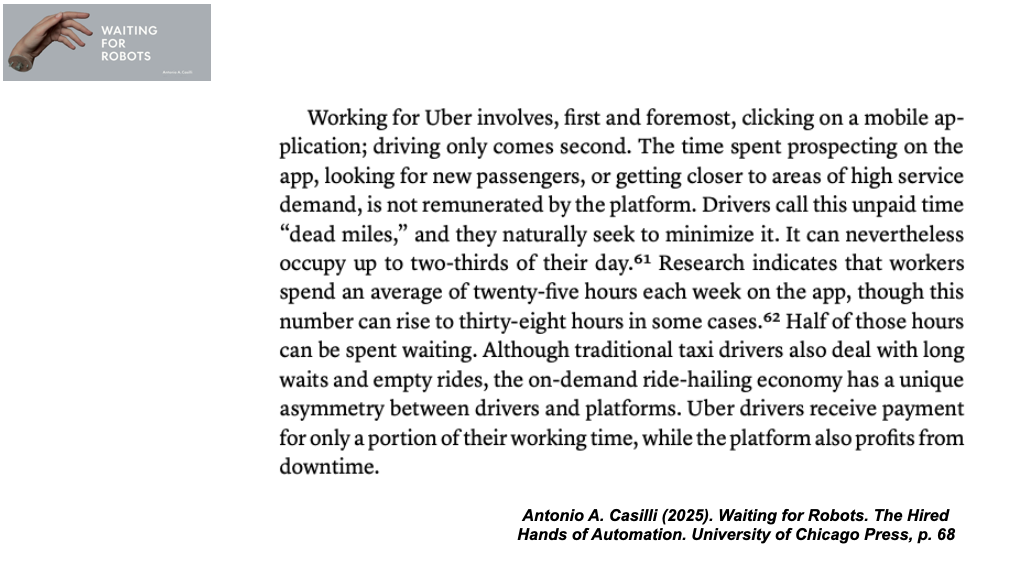
Is this good news? Will workers earn more? Don’t celebrate yet. Data work is performed globally, and no one has become wealthy from it. Our own DiPLab research conducted in high-, mid-, and in low-income countries shows that labeling data for AI can pay as little as $6 per month or at most around $120.
What we might hope for is an entirely different type of convergence: that of workers’ struggles themselves. As more platforms merge these labor forms, struggles for recognition and improved working conditions may also coalesce—and moves like this could accelerate that process. Gig workers have organized for a decade, winning changes to laws and policies. Data workers have increasingly unionized across Africa, Europe, and the United States. Collective action among content creators is now emerging, with a proliferation of creator unions, guilds, and cooperatives sparked by protests against AI companies’ data scraping practices.
Postscript: Why You Should Care
If you’re a formal employee with a traditional contract, you might wonder why any of this matters to you. After all, you are neither an Uber driver nor a data worker. Why should you be concerned? The answer lies in Uber’s historical and cultural influence on how we conceptualize work itself.
The term “uberization” didn’t emerge by accident—it describes a broader transformation: the breaking down of stable jobs into taskified, on-demand labor, overseen by algorithmic systems and systematically underpaid. What begins as a model for platform workers rarely stays confined to that sector. Platforms serve as testing grounds where industrialists experiment with ideas they plan to roll out across all labor markets. Uber and companies like it have repeatedly demonstrated their capacity to reshape labor norms across sectors as diverse as logistics, hospitality, and personal care, turning what was once unthinkable into the new standard. In their wake, even traditionally stable professions have begun to absorb gig-like features—flexible scheduling, task-based pay, algorithmic oversight, and the normalization of precarious autonomy—blurring the boundaries between formal employment and platform labor.
The Great Digital Labor Convergence isn’t just about ride-hail drivers picking up data annotation gigs during downtime. It’s a preview of a future where all work, including yours, could be fragmented, datafied, and algorithmically managed. The question isn’t “Why should I care?” The real question is: what will you say to your boss when they ask you to label data during your lunch break?